

What is id_in_provider_system
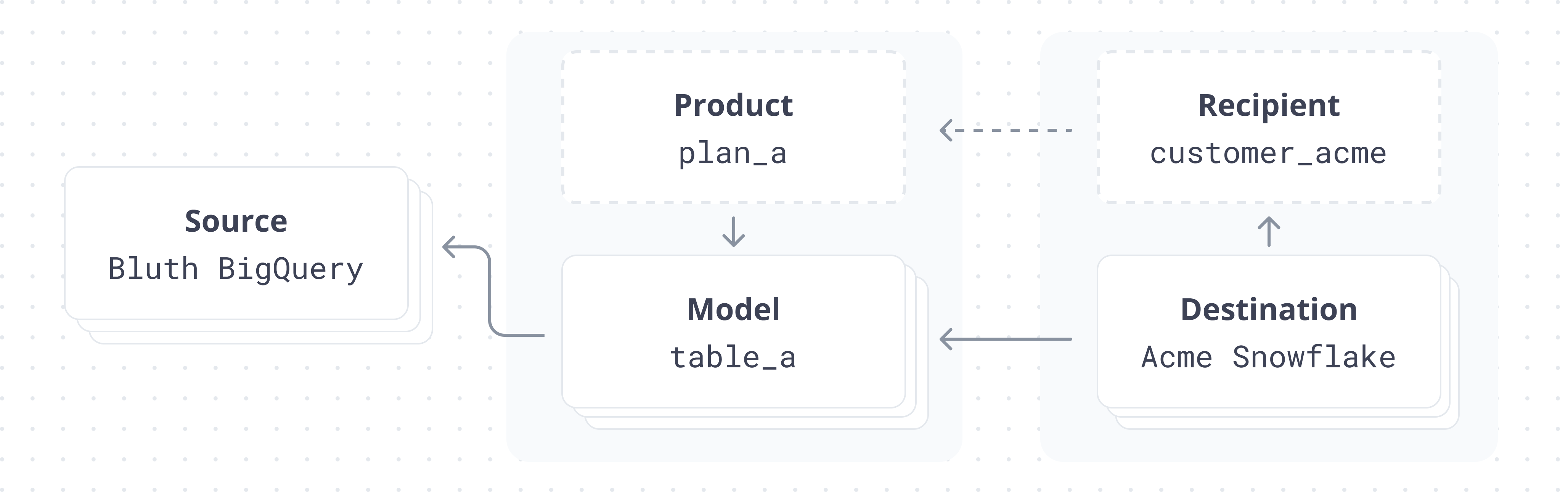
id_in_provider_system refers to the recipient’s identifier by which data will be filtered per organization. In other words, it is the link between a Prequel Recipient and the corresponding identifier in the data source.
In multi-tenant tables mode, the value assigned to this key will be matched against the values under the organization_id column provided for every table.
In schema-tenanted mode, the value must be the tenant’s exact schema name in the source, and each transfer reads the recipient’s data from that schema.
Resolving multiple recipients and destinations
Prequel enforces a key rules on uniqueness of Recipients and Destinations:- Multiple Recipients cannot point to the same Destination. Prequel’s change detection logic relies on guarantees of a destination’s state on any given transfer, such that writing multiple recipients’ data to the same table can cause non-deterministic transfer behavior.
- To write data from multiple recipients to the same database or warehouse, it is required that one Prequel Destination is defined for each Recipient, where each Destination must have a unique schema to avoid collisions.
- Each
id_in_provider_systemmust be unique.
Using schema-based tenanting
Prequel supports schema-based tenanting. To add a destination using schema-based tenanting, first configure arecipient whose id_in_provider_system is set to the tenant’s schema name in the source, then create the destination. Read more about multi-tenancy in Prequel here: Multi-tenancy.
Updating products for a given destination
When adding a Destination for a given Recipient for the first time, Prequel provides a helpful shortcut to abstract away the need to create the Recipient beforehand (that is, if a Destination is created with aid_in_provider_system that has not been used, the Recipient with that id_in_provider_system is created behind the scenes).
However, when Products need to be updated for a Recipient, that update must happen on the Recipient object, using the PATCH /recipients/{recipient_id} endpoint.
Using role-based access control on a source
Prequel supports using specific source users for a given recipient’s data. To add a specific set of credentials that should be used to access source data for a given recipient, you can use thePOST /recipient-source-credentials endpoint.