

Prerequisites
- If your Redshift security posture requires IP whitelisting, have our static IP available during the following steps. It will be required in Step 2.
- By default, Redshift authentication uses role-based access. You will need the trust policy prepopulated with our identifier to grant access. It should look similar to the following JSON object with a proper service account identifier:
Trust policy
Network allowlistingCloud Hosted (US):
35.192.85.117/32Cloud Hosted (EU): 104.199.49.149/32If private-cloud or self-hosted, contact support for the static egress IP.How authentication works
Two identities involvedAWS IAM Role (in your AWS account)You create this role in Step 3 and enter its ARN in the destination form. It holds the S3 staging permissions and allows us to call
redshift-serverless:GetCredentials on your workgroup. We assume it to obtain short-lived credentials.Redshift database user (in your Redshift workgroup)Redshift derives this user from the IAM identity used to authenticate. You create this user and grant it privileges in Step 1.- IAM role (recommended)
- AWS user with HMAC access key
The database user is
IAMR:<role-name>, where <role-name> is the final segment of the IAM role ARN entered in the destination form. The ARN arn:aws:iam::123456789012:role/transfer-role connects as IAMR:transfer-role.1
Create the Database User in Redshift
Connections are made as a database user named after your IAM identity. Decide now on the name of the IAM role you will create in Step 3 (for example,
transfer-role). The database user is that role name prefixed with IAMR:.- Connect to Redshift using the SQL client.
- Execute the following query to create the user for your auth method. The quotes are required because the name contains a colon.
- IAM role (recommended)
- AWS user with HMAC access key
The name must exactly match
IAMR: followed by the role name from Step 3.Create user
User already exists?Redshift creates this user automatically the first time we connect. If a connection attempt has already been made, the
CREATE USER statement will fail with a “user already exists” error. Skip it and run the grant below.- Grant the user
createandtemporaryprivileges on the database.createallows the service to create new schemas andtemporaryallows the service to create temporary tables.
Grant privileges
The schema will be created during the first syncThe schema name supplied as part of Step 4 will be created during the first connection. It does not need to be created manually in the destination ahead of time.
2
Whitelist connection
- In the Redshift console, click Workgroups, and make a note of the workgroup name.
- Select the workgroup you would like to connect.
- In the General information pane, make note of the Endpoint details. You may need to use the copy icon to copy the full details to discover the full endpoint and port number.
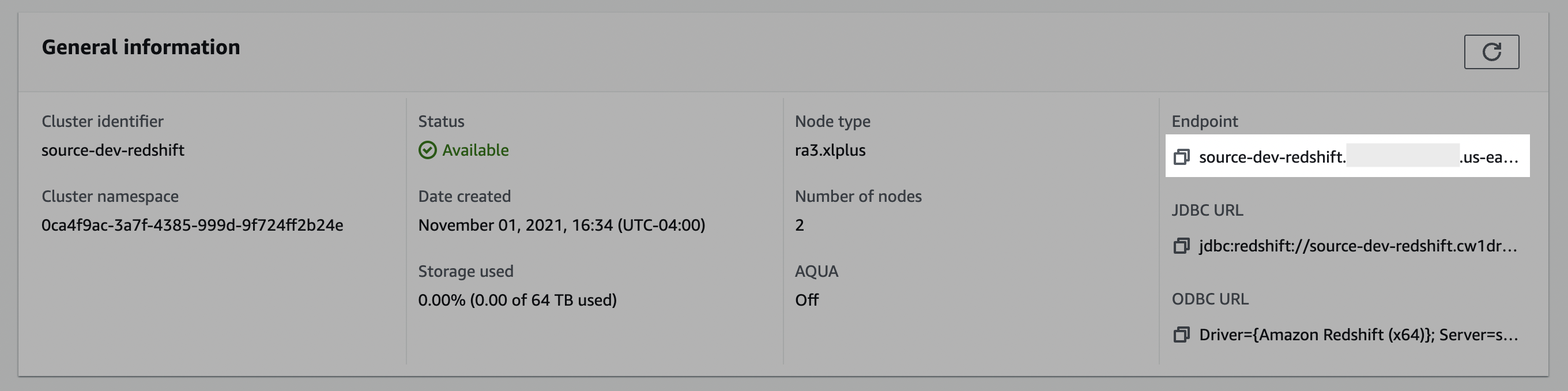
- Click the Properties tab.
- Scroll down to the Network and security settings section.
- In the VPC security group field, select a security group to open it.
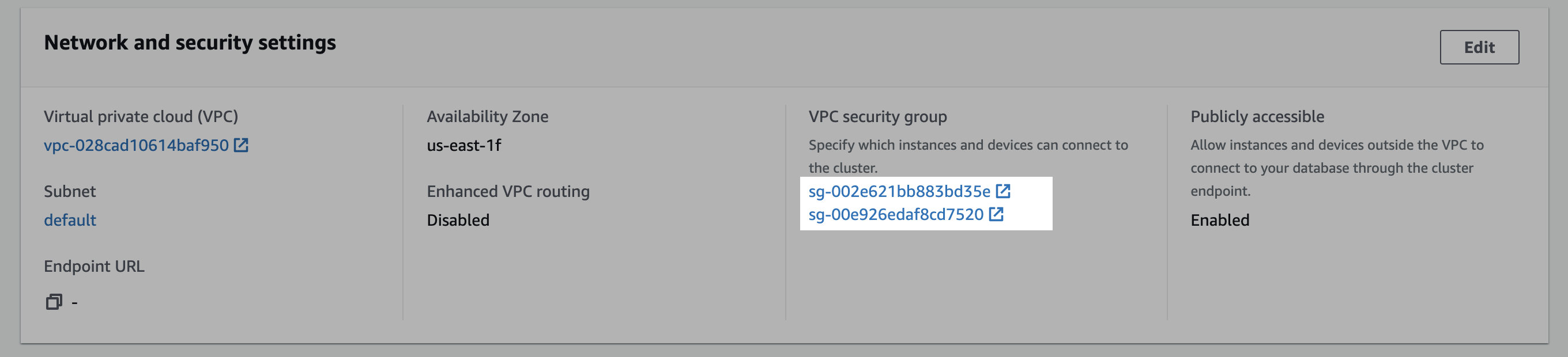
- In the Security Groups window, click Inbound rules.
- Click Edit inbound rules.
- In the Edit the Inbound rules window, follow the steps below to create custom TCP rules for the static IP:
a. Select Custom TCP in the drop-down menu.
b. Enter your Redshift port number. (likely
5439) c. Enter the static IP. d. Click Add rule.
3
Create a staging bucket
Create staging bucket
- Navigate to the S3 service page.
- Click Create bucket.
- Enter a Bucket name and modify any of the default settings as desired. Note: Object Ownership can be set to “ACLs disabled” and Block Public Access settings for this bucket can be set to “Block all public access” as recommended by AWS. The bucket must be created in the same AWS Region as your Redshift Serverless workgroup. Make note of the Bucket name and AWS Region.
- Click Create bucket.
Optional: Add a short retention lifecycle policyYou may configure a lifecycle rule on the staging bucket to automatically delete objects older than 2 days as the bucket is not used to persist data. In the bucket Management tab, click Create lifecycle rule, set an expiration action for current versions of objects with a 2-day age. Note that transfer logic automatically cleans up files after transfer completion, so this is an optional step.
Create policy
- Navigate to the IAM service page, click on the Policies navigation tab, and click Create policy.
- Click the JSON tab, and paste the following policy, being sure to replace
BUCKET_NAMEwith the name of the bucket chosen above, andREGION_NAME,ACCOUNT_ID, andWORKGROUP_NAME_OR_IDwith the proper Redshift Serverless values.- Note: the first bucket permission in the list applies to
BUCKET_NAMEwhereas the second permission applies only to the bucket’s contents (BUCKET_NAME/*), an important distinction.
- Note: the first bucket permission in the list applies to
Access policy
KMS encryption (optional)If your S3 staging bucket uses KMS encryption (CMK), add the following statement to the Replace
Statement array of your IAM policy to allow data encryption/decryption with your KMS key. Encryption with SSE-C is not currently supported.KMS policy statement
REGION_NAME, ACCOUNT_ID, and KEY_ID with your values.- Click through to the Review step, choose a name for the policy, for example,
transfer-service-policy(this will be referenced in the next step), add a description, and click Create policy.
- IAM role (recommended)
- AWS user with HMAC access key
Create role
- Navigate to the IAM service page.
- Navigate to the Roles navigation tab, and click Create role.
- Select Custom trust policy and paste the provided trust policy (from the prerequisite) to allow AssumeRole access to this role. Click Next.
- Add the permissions policy created above, and click Next.
- Enter a Role name, for example,
transfer-role, and click Create role. - Once successfully created, search for the created role in the Roles list, click the role name, and make a note of the ARN value.
4
Add your destination
Use the following details to complete the connection setup: workgroup, host, database, your chosen schema, IAM role ARN (or access keys), and staging bucket details. The final segment of the IAM role ARN must match the role name used for the database user in Step 1.
Permissions checklist
- Redshift database user
"IAMR:<role-name>"(or"IAM:<user-name>"for access key authentication) exists and hasCREATEandTEMPORARYon the database. If you pre-created the schema, ensureGRANT ALL ON SCHEMA <schema> TO "IAMR:<role-name>". - IAM role trust policy allows us to assume the role.
- IAM policy includes:
redshift-serverless:GetCredentialson your targetworkgroupARN (Serverless uses workgroups, not clusters).- S3
ListBucketonarn:aws:s3:::BUCKET_NAME. - S3
GetObject,PutObject,DeleteObjectonarn:aws:s3:::BUCKET_NAME/*.
- Network allowlisting (if enforced) permits egress IP/CIDR for the Redshift port (typically 5439).
FAQ
How is the Redshift connection secured?
How is the Redshift connection secured?
We use role-based authentication with your AWS IAM Role. We assume your role to obtain short-lived database credentials and network access can be constrained by allowlisting the static egress IPs noted above.
Why is an S3 bucket required?
Why is an S3 bucket required?
Redshift’s high-throughput path loads data from S3 using
COPY. We stage files briefly in your bucket to maximize throughput and reliability. Files are cleaned up after load. We require ListBucket to enumerate staged files and GetObject/PutObject/DeleteObject to write, read back, and delete staged files.Why do you need redshift-serverless:GetCredentials on the workgroup?
Why do you need redshift-serverless:GetCredentials on the workgroup?
In Serverless, temporary database credentials are issued per workgroup. Granting this action on the target workgroup allows our assumed role to obtain ephemeral credentials for the database user without long-lived secrets, improving security and auditability.
What are the oaud vs sub IDs used for?
What are the oaud vs sub IDs used for?
These are identity claims used in the IAM trust policy when federating from GCP to AWS.
sub uniquely identifies our Google principal in federation. oaud is an additional claim used to bind role assumption to your organization.Why am I getting authentication errors with Redshift Serverless?
Why am I getting authentication errors with Redshift Serverless?
Common causes:
- Missing or incorrect permission on
redshift-serverless:GetCredentials(ensure it targets the correct workgroup ARN and region/account). - Trust policy mismatch (our principal isn’t permitted to assume your role).
- Using a Cluster ARN or
redshift:GetClusterCredentialsinstead of Serverlessworkgroup+redshift-serverless:GetCredentials. - Database permission errors: privileges were granted to a manually created user instead of the auto-generated
"IAMR:<role-name>"user. Grant privileges to the IAM-derived user described in Step 1. - Propagation delay: IAM changes can take a few minutes to apply. Retry after 5-10 minutes.
Do I need to pre-create the schema?
Do I need to pre-create the schema?
No. The schema provided in the destination configuration is created automatically on first sync. If you pre-create it, grant
ALL on the schema to the writer user and you may remove the database-level CREATE permission (retain TEMPORARY).